The Descent into Sneffels
A Journey to the Centre of the EarthThe Descent into Sneffels is the expedition’s decisive passage from the surface into the underground, beginning when the shadow of Scartaris marks the correct opening and continuing as Henry Lawson, Professor Hardwigg, and Hans enter the volcanic gallery. The scene turns a cryptographic instruction into a physical route, and a prepared scientific venture into an encounter with a world that will resist the explorers’ expectations.
Finding the Entrance
The route depended on a precise conjunction of place and time. Of the three openings in the crater, only one matched the instruction in Saknussemm’s cryptogram: the shadow of Scartaris had to fall upon the mouth of the shaft in the last days of June. The mountain peak thus served as the pointer of an immense sundial, making the correct passage legible through sunlight rather than through any visible mark at the openings themselves.
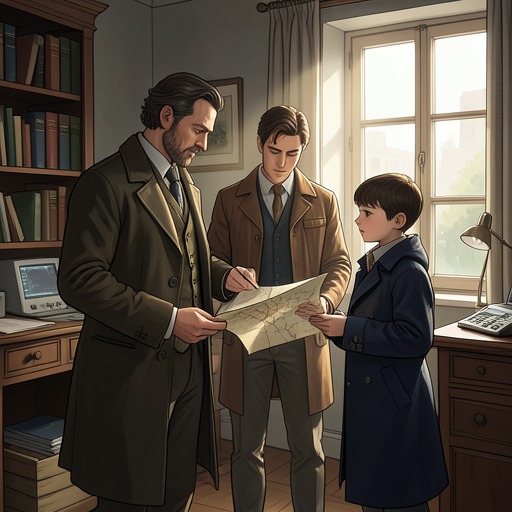
Cloud cover nearly prevented the test. On June 25 the sky was still overcast, and without a shadow the party could not distinguish the proper shaft. A further six days of cloud would have forced them to postpone the attempt for a year. The weather changed on June 28: sunlight reached the crater floor, and the shadow of Scartaris moved across it. At noon, when the sun stood at its highest, the shadow fell on the edge of the central pit. The astronomical sign converted uncertainty into direction, and Professor Hardwigg announced that they had found the entrance to the Interior of the Earth. Hans answered calmly, accepting the order to go forward.
Crossing the Threshold
The narrative marks the descent as the beginning of the real journey. Until then, the travelers’ courage and determination had carried them through fatigue and other difficulties; now they faced unknown dangers. Henry had not yet looked down into the abyss and could still refuse to participate. But Hans’s composure made retreat feel like a failure of nerve, and Henry went on despite his fear.
The shaft was steep-sided, nearly vertical, and broken by projections that could serve as footholds. Professor Hardwigg solved the problem of descending without leaving a rope fixed at the top: he used a cord about as thick as Henry’s thumb and at least four hundred feet long, looped around a large block of lava. Each explorer could descend on the doubled cord, then release one end and pull the other free once below. The method made the downward journey practicable, but did not settle Henry’s more troubling question of how they would climb out again.
On June 29, after breakfasting on biscuit and dried meat with a little water flavored with Schiedam, Professor Hardwigg recorded the expedition’s observations in his travel notebook. The record gives the crossing a measured, documentary frame: instruments and direction are noted even as the travelers enter a place no one in their party had seen. Hardwigg then declared that their first step into the Interior of the Earth was about to begin. With a Ruhmkorff electric lamp lit, Hans went first, the Professor followed, and Henry brought up the rear.
The Volcanic Passage
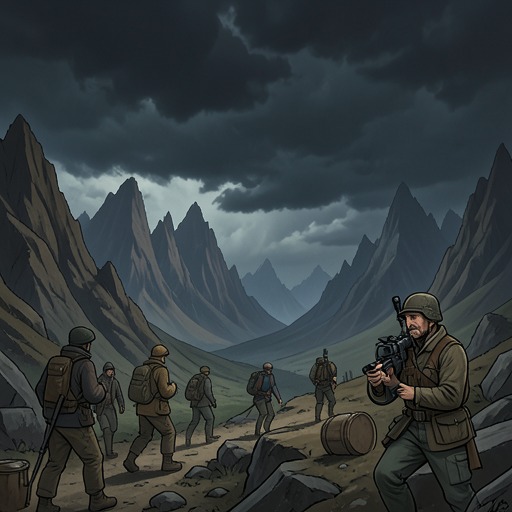
The gallery was not an untouched natural corridor. A lava stream from the 1219 eruption of Sneffels had forced its way through the tunnel and left a thick, brilliant lining. The electric light intensified the shine. The passage’s beauty did not make it safe: its steeply inclined floor threatened to send the travelers sliding downward, and they had to use cracks and irregularities as steps while lowering their heavy luggage ahead of them on a long cord.
The same lava that made the slope treacherous also shaped its strange surfaces. In some places it formed stalactites; elsewhere its porous crust rose into rounded blisters. Opaque quartz and drops of natural glass hung from the roof, catching the lamps’ light. The passage consequently serves as both route and geological record: the travelers move through the trace of an eruption, reading its material effects even as they struggle to cross them.
The lamps also made the descent possible amid inflammable and combustible gases. The party carried a second apparatus for Hans, and the electric light supplied what the dark gallery denied: a workable field of vision. The explorers’ equipment did not abolish danger, but let them advance through it. Their first steps below ground therefore depend as much on practical arrangements—cord, footholds, lamps, and ordered burdens—as on the Professor’s confidence in the destination.
Observation and the Limits of Theory
The descent establishes a pattern that recurs deeper underground: Professor Hardwigg’s scientific confidence is tested against what the party can measure and see. Later, when Henry reports a thermometer reading of 27.6 degrees, the Professor says that the result contradicts the expected increase of heat with depth by 1,474.4 degrees. He treats the discrepancy as evidence against the proportional-temperature theory and in favor of Humphry Davy’s account of Earth’s interior. The passage thus begins an expedition in which instruments do not merely accompany the travelers; their readings can unsettle the framework through which the travelers interpret the world.
That tension becomes sharper as other observations accumulate. At the underground shore, Professor Hardwigg examines a fish with a flat head, rounded body, bony lower extremities, toothless mouth, and unusually developed pectoral fins. Henry takes it for a small sturgeon, but the Professor identifies it as belonging to a family thought extinct, known to naturalists only from fossils in Devonian strata. The identification makes the subterranean environment a challenge to ordinary divisions between living observation and the fossil record.
The expedition’s discoveries also resonate with a scientific dispute that predates its departure. In 1863, a human jawbone was found fourteen feet below ground at Moulin-Quignon, near Abbeville, together with stone hatchets and carved flints. The discovery provoked controversy among European scholars over the antiquity of human remains. Against this background, the possibility of encountering evidence of ancient life below the surface is not merely a marvel: it presses on unsettled questions about what counts as proof and how far accepted chronology can be revised.
The instruments themselves are not infallible guides. Much later, amid boiling water and excessive heat, Henry examines the compass and finds its needle jumping from pole to pole, circling, and reversing course. The descent begins with a shadow that points reliably to the right entrance; in the deeper world, a familiar instrument can become bewildering. This contrast gives the threshold scene its broader significance: the expedition sets out by translating a natural sign into a route, but entry below ground begins a journey in which observation remains indispensable precisely because certainty cannot be taken for granted.